Shift Bidding: How It Works vs Shift Swapping
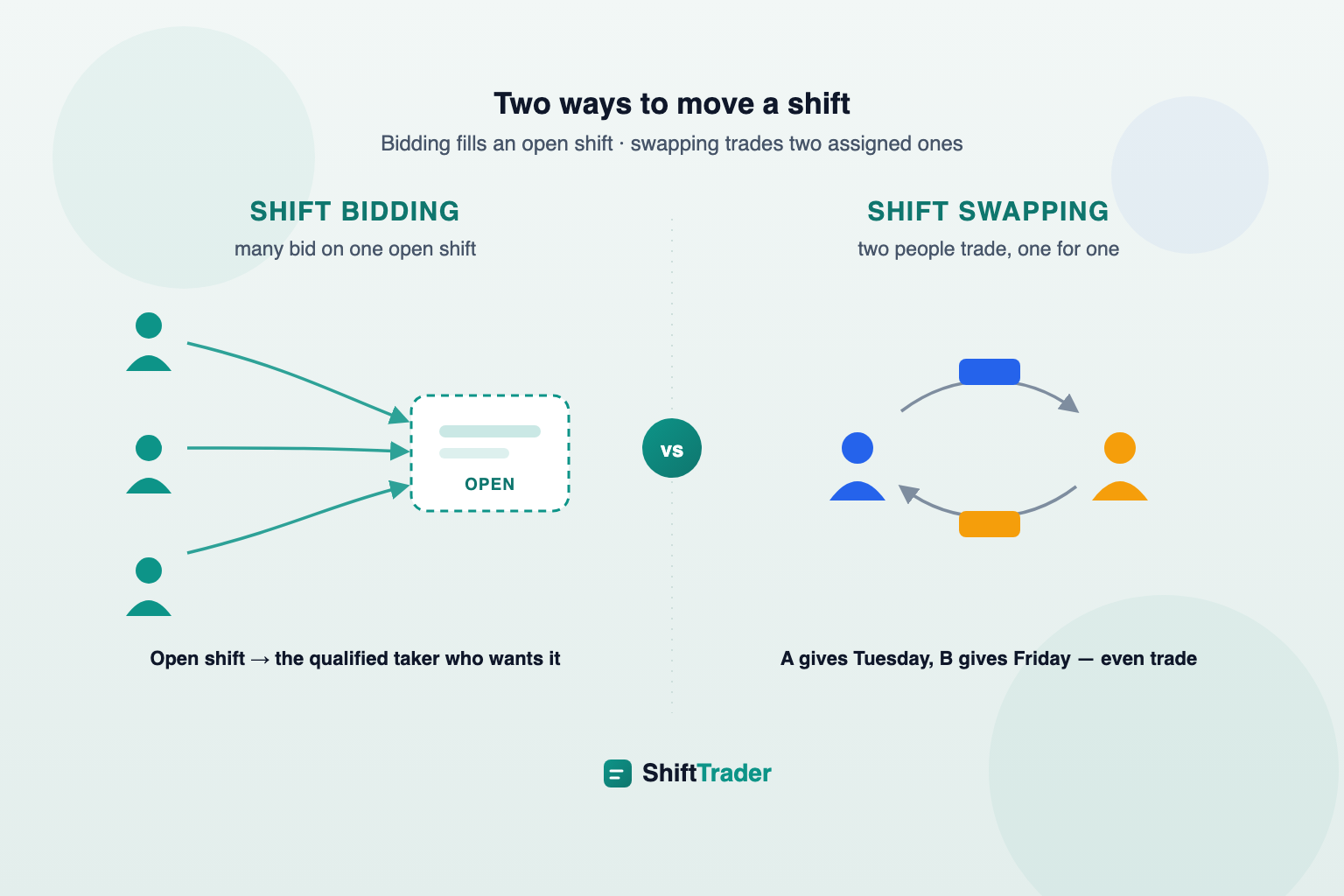
When a shift needs coverage, teams reach for one of two models without always naming them. In shift bidding, an open shift is posted and eligible employees put in for it — the shift goes to whoever bids and qualifies. In shift swapping, two employees trade shifts they already own. Both get the schedule covered; they solve different problems, and using the wrong one is where friction starts.
This guide explains how shift bidding works, how it differs from swapping and pickups, and when each one is the right tool.
What Is Shift Bidding?
Shift bidding is a way to fill open shifts — hours nobody is assigned to yet. Instead of a manager hand-picking who works them, the open shift is published to a group and employees bid on the ones they want. The manager (or a rule) then awards each shift.
The open shift usually comes from one of three places:
- Unassigned hours the schedule was built with — a Saturday night that was never staffed
- A gap left by a call-out — someone is sick and their shift needs a taker
- Extra demand — a busy week that needs more bodies than the base schedule has
Bidding turns "who can I call?" into "who already raised their hand?" The people most willing to work those hours surface themselves, which is faster than a manager working down a phone list.
Shift Bidding vs Shift Swapping vs Pickups
These three get used interchangeably, but they move shifts differently:
| Model | Starts with | Moves | Needs a second employee? |
|---|---|---|---|
| Shift bidding | An open, unassigned shift | Open shift → one bidder | No |
| Shift swapping | Two assigned shifts | Employee A's shift ↔ Employee B's shift | Yes — a mutual trade |
| Pickup | One assigned shift someone can't work | That shift → one taker | No — a one-way handoff |
The practical difference is ownership. A swap requires two people who each want what the other has, which is why swaps stall — the match has to exist. Bidding and pickups are one-directional: a shift needs a taker, and anyone eligible can be that taker. That makes them faster to fill, especially at short notice.
If your immediate problem is "two people want to exchange days off," that's a swap — see our guide on how shift swapping works. If the problem is "these hours have no name on them," that's bidding or a pickup.
How Open Shift Bidding Works, Step by Step
A workable bidding flow has five steps:
- Post the open shift to the group, with its date, time, role, and any qualification it requires.
- Set who can bid — the whole team, or only employees trained for that role and not already over their hours.
- Collect bids during a window. Employees indicate they want the shift.
- Award it — either automatically by a rule (first eligible bidder, or seniority) or by a manager choosing from the bidders.
- Update the schedule the moment it's awarded, so the shift shows a name and nobody else keeps bidding on a filled slot.
The two decisions that make or break it are eligibility and awarding. Let those bids come from anyone and you'll award a specialized shift to someone who can't do it. Make a manager approve every single bid and you've rebuilt the bottleneck bidding was meant to remove. The right setting is usually in the middle: auto-award the clear-cut shifts to any eligible bidder, and route only the edge cases — overtime, split qualifications — to a manager.
When Shift Bidding Is the Right Model
Bidding earns its keep when there are more open shifts than a manager can place by hand, and when employees actually want extra hours. It fits:
- Healthcare — floating open shifts across a unit where several nurses are cross-trained and happy to pick up extra hours
- Retail and hospitality — seasonal peaks where the base schedule is deliberately light and extra shifts get opened as demand firms up
- Warehouse and logistics — surge days where the question is simply "who wants the overtime?"
It fits poorly when open shifts are rare, when almost nobody wants more hours (bidding on an empty room just delays the manager making a call), or when every shift needs the same one qualified person — in that case there's no real pool to bid.
The Failure Mode: Bidding in a Group Chat
Most teams already run an informal version of shift bidding: a manager drops "anyone want Friday night?" into a group chat and takes the first reply. It works until it doesn't:
- The first reply isn't the eligible one. The fastest thumbs win, not the trained employee.
- Two people are told yes. By the time the manager reads up, the shift's been promised twice.
- The schedule of record drifts. The chat says one thing, the posted schedule says another, and payroll finds out later.
- Overtime is discovered after the fact. Nobody checked hours before saying yes.
The pattern is the same one that breaks group-chat swaps and pickups: the rules live in a manager's head instead of in the tool where the shift is claimed.
Turning Bidding Into a Process
The fix is to put the rules where the shift is claimed. Eligibility is checked when the shift is posted, so only qualified employees can take it. Overtime is flagged before the shift is confirmed, not after. And the schedule updates the instant it's claimed, so there's one source of truth and no double-promises.
That's the idea behind open shift marketplaces: open hours go to a shared board, eligible people claim them, and the schedule stays current — without a manager brokering every message.
ShiftTrader takes the simplest version of this: the pickup. An open shift is posted to the group, and the first eligible coworker who wants it claims it — no bid window, no award step to run. For most teams that's the point of bidding anyway (open shifts filled fast by willing, qualified people), reached with one tap instead of a formal process. Our guide to picking up open shifts walks through how a taker claims a shift without a trade.
Formal bidding earns its extra steps when several people want the same shift and you need a fair, transparent way to choose between them. If that's your situation, a bid-and-award flow is worth the overhead. If it isn't — and for most teams it isn't — a straight pickup gets the shift covered with far less ceremony.
Shift bidding, swapping, and pickups aren't competing systems — they're three answers to three different questions. The teams that run coverage smoothly know which question they're asking and reach for the model that fits, instead of forcing every gap through the same group chat.
Tired of chasing open shifts in a group chat? Try ShiftTrader free and give your team one place to post open shifts, pick up the ones they want, and keep the schedule in sync.