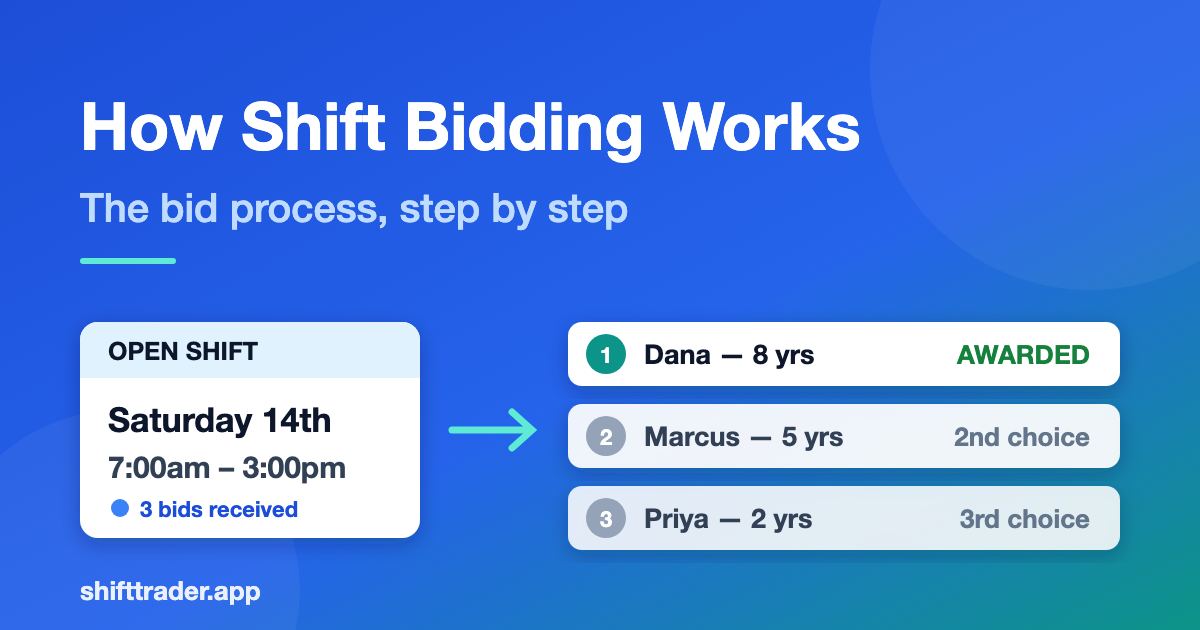
How Shift Bidding Works: The Bid Process Step by Step
Shift bidding is how a schedule gets built when the employer decides what needs covering and the employees decide who covers it. Management publishes the shifts. Employees put in for the ones they want. An award rule — seniority, a performance score, first-come — decides who gets what.
It shows up under different names. Call centers run a formal "bid" every quarter. Hospitals post open shifts and let nurses claim them. Warehouses publish next week's overtime and take requests. The vocabulary changes; the mechanics don't.
This guide walks through the bid process in order, explains the two award rules almost everyone uses, and covers the specific places it goes wrong. If you're trying to work out whether you need bidding at all, our comparison of shift bidding vs shift swapping is the better starting point.
The Six Steps of a Shift Bid
Every bid process — formal or informal, quarterly or same-day — runs the same six steps.
1. Management Builds the Bid Package
Before anyone bids, someone decides what's on offer. In a call center that's a full set of schedule lines for the next quarter. On a hospital unit it's the open shifts left after the base roster. In a warehouse it's next week's overtime.
The package needs three things nailed down before it's published:
- Exactly what's being bid. A whole recurring schedule line ("Mon–Fri 10am–7pm") is a different object from a single open shift on the 14th. Mixing them in one bid confuses everyone.
- How many of each are available. Two people can't win the same shift.
- Eligibility per item. Which certification, training, or department each shift requires — and therefore who is allowed to bid on it at all.
That third item is the one most often skipped, and it's the one that makes the award step painful later.
2. The Bid Window Opens
The package is published to everyone eligible, with a hard close date. A window is required for any award rule other than first-come: seniority can't be applied to bids that arrive one at a time.
Practical window lengths:
| Bid type | Typical window |
|---|---|
| Quarterly schedule bid (call center) | 5–10 business days |
| Monthly open shifts | 3–5 days |
| Next-week overtime | 24–48 hours |
| Same-day coverage | No window — first come |
Shorter than this and part-timers and people on leave miss it entirely. Longer, and the schedule is stale before it's awarded.
3. Employees Rank Their Choices
This is the step that separates a bid from a request. Employees don't pick one shift — they submit a ranked list: first choice, second choice, third, and so on.
Ranking matters because it's the only way to award efficiently. If everyone submits a single choice and forty people all pick the same Friday, thirty-nine of them get nothing and you run the bid again. With ranked lists, the award pass falls through to each person's next available choice automatically.
Two rules make ranking work:
- Require enough choices to be safe. A common rule is rank at least twice as many shifts as you need. Someone who ranks exactly one shift and doesn't win it gets whatever's left.
- State what happens if someone doesn't bid. Usually: assigned to whatever remains after the bid closes. Say it in writing, before the window opens.
4. Bids Are Awarded
The window closes and the award rule runs. Two rules cover almost every real system.
Seniority-based. Sort employees by hire date. The most senior person gets their first choice. The next gets their highest-ranked choice that's still available. Continue down the list. This is what unionized call centers, airlines, and many hospital systems use, and it's frequently written into the collective agreement rather than chosen.
Score-based. Same pass, but the sort key is a performance or attendance metric instead of hire date. Common in non-union contact centers, where schedule preference is used as a reward. It's a stronger incentive than seniority — and a much bigger source of disputes, because the ranking is a judgment and hire dates aren't.
Whichever you use, the pass is the same: sort people, then walk the list once, giving each person their best still-available choice. Two properties make it defensible — it's deterministic (same inputs, same result, every time) and it's explainable (anyone can be shown precisely why they got what they got).
A third rule, first-come-first-served, skips the window and the sort entirely: the shift goes to whoever claims it first. It's not really bidding — it's a race — but for same-day coverage it's the correct answer, because speed is the only thing that matters when a shift starts in four hours.
5. Results Are Published and the Schedule Updates
Awards go out and the schedule of record changes. This is the step teams get wrong most often: the bid is awarded in a spreadsheet, the results are emailed, and the actual schedule is updated by hand days later — or not at all.
Everything downstream depends on the schedule being current. If payroll, time clocks, and the posted roster still show pre-bid assignments, the bid didn't finish, it just moved the problem.
6. Leftovers Are Assigned
Some shifts get no bids. Somebody has to work them.
Decide the rule for this before the bid, not after — it's the least popular part of the process and the one most likely to be contested. The usual options are reverse seniority (least senior gets the leftovers), rotation (tracked across bid cycles so the same people aren't hit every time), or a premium rate to attract voluntary bids on the shifts nobody wants.
Rotation is the fairest of the three and the only one that requires you to keep records between cycles. That's usually the reason teams don't use it.
How Call Center Shift Bidding Works
The call center shift bid is the most formal version of this process, and it's where most of the terminology comes from.
The cycle typically runs quarterly. Workforce management forecasts call volume by interval, builds schedule lines to match it — a line being a complete recurring weekly schedule, including days off — and publishes the full set for bidding. Agents rank the lines, awards run by seniority or a performance score, and the results become the schedule for the next quarter.
Two things make it different from open-shift bidding elsewhere:
- Agents bid on whole recurring schedules, not individual shifts. Winning a line means winning that pattern for the entire quarter.
- The line set is fixed by the forecast. The number of people needed at 9am on Tuesday isn't negotiable, so bidding distributes an already-determined set of schedules rather than shaping demand.
Everything else — the ranked list, the single ordered award pass, the leftover problem — is the same process described above.
Where the Bid Process Breaks
Four failures account for nearly all the disputes.
The rules weren't written down before the bid. The award rule, the tiebreaker, the leftover rule, and the "didn't bid" rule all need to be published before the window opens. Deciding a tiebreaker after seeing who's affected is how a routine bid becomes a grievance.
Eligibility is checked after the award, not before. Someone wins a shift they aren't certified for, the award is pulled back, and every award below theirs shifts. Filter the bid list by eligibility at publish time and this can't happen.
Overtime is discovered in payroll. A bid that gives someone forty-eight hours is a bid that just committed the employer to overtime nobody approved. Hours need to be totalled at award time, not at the end of the pay period.
The bid happens in a group chat. For informal open-shift bidding this is the default, and it fails predictably: no window, so early responders effectively win regardless of the stated rule; no eligibility check; and no way to prove afterwards who asked first. Writing the rules down first is the fix; our shift swap policy template covers the clauses that apply.
When You Don't Need a Bid at All
Bidding exists to solve one problem: more people want a shift than there are slots. It's a fair, transparent way to choose between competing claims.
If that's not your problem, the process is overhead. Most teams posting open shifts don't have forty people fighting over one Friday — they have one shift and a hope that somebody takes it. There, a bid window is a delay, not a fairness mechanism, and the honest answer is a pickup: post the open shift, let the first eligible coworker claim it, done.
A quick test — you need real bidding if all three are true:
- Multiple qualified people routinely want the same shift
- Somebody would contest the outcome if it looked arbitrary
- You can defend the award rule in writing
If any one of those is false, open shift pickups get the same shift covered with none of the ceremony. And if the problem is people trading shifts they already own rather than claiming new ones, that's shift swapping, which is a different mechanism again.
Making It Work Without Formal Bidding Software
Most teams sit between "spreadsheet and hope" and a full workforce management suite. You can get most of the benefit from three habits:
- Publish open shifts to everyone at once, not to individuals in sequence. Sequential asking is slow and quietly rewards whoever the manager thinks of first.
- Check eligibility and hours when the shift is claimed, not afterwards. This is the single highest-value automation, because it prevents the two expensive errors — unqualified coverage and unplanned overtime.
- Keep one schedule of record. The moment a shift is claimed, the schedule everyone reads should show it. Every double-booking traces back to two versions of the truth.
Shift Trader does the informal version of this: shifts are posted to a group, everyone sees the same schedule, and open shifts can be picked up by any eligible coworker with both sides notified. Overlapping shifts are rejected before they're created, so a claimed shift can't quietly become a double. There's no bid window and no award step — which is the point, for teams whose real problem is filling shifts rather than rationing them.
The Short Version
A shift bid is six steps: build the package, open a window, collect ranked choices, run one ordered award pass, publish results and update the schedule, then assign what's left over. Seniority and performance score are the two award rules that matter, and both work the same way — sort people, walk the list once, give each their best remaining choice.
Write every rule down before the window opens, filter by eligibility at publish time, and total hours at award time. And before running a bid at all, check that you actually have competing demand for the same shifts. If you don't, you don't need a bid — you need a faster way to post open shifts.
Filling open shifts one text message at a time? Try ShiftTrader free — post an open shift to your group, let the first eligible coworker claim it, and keep one schedule everyone can see.