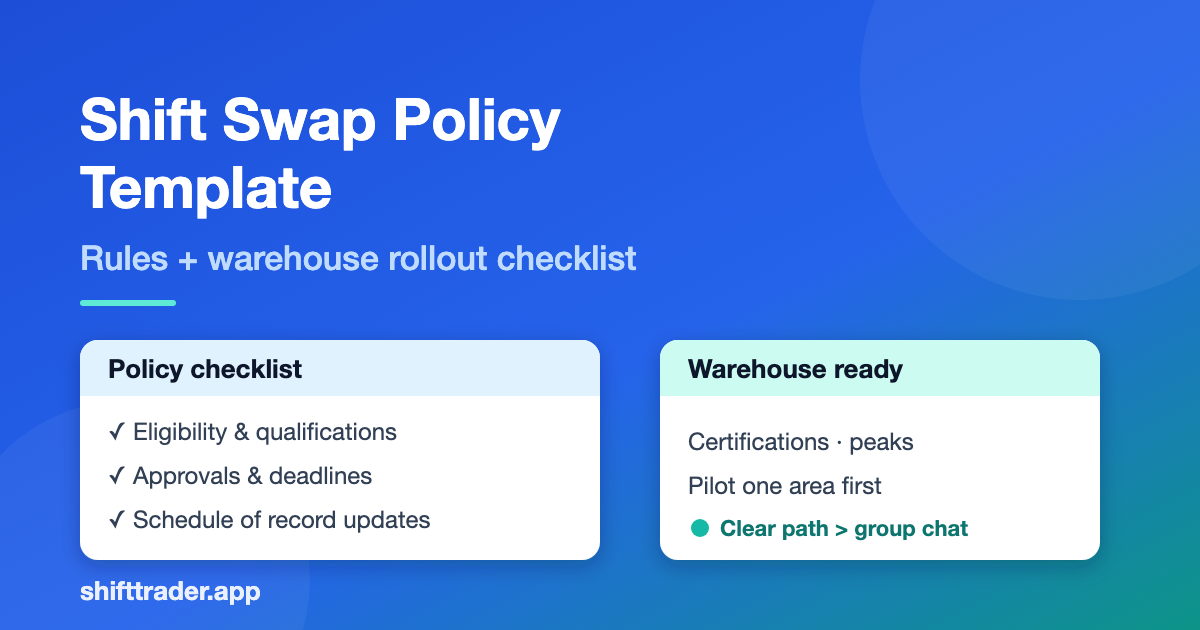
Shift Swap Policy Template (and How to Roll It Out)
Unclear shift-swap rules create the same problems every week: last-minute group texts, unqualified coverage, double-booked names, and supervisors chasing confirmation after the roster was already printed.
A written shift swap policy fixes the ambiguity. It tells employees when they can trade, who must approve, what “qualified” means, and how the official schedule gets updated. For warehouse and other shift-based operations, that clarity protects coverage on the floor—and reduces manager overhead.
This page includes a usable policy template (checklist + sample language) and a practical rollout plan. It assumes peer-to-peer trades among coworkers—not a public job board or gig marketplace.
Why warehouse and shift teams need a written swap policy
Warehouse floors run on timing: inbound windows, outbound cutoffs, equipment certifications, and break coverage. Informal “text someone and hope” trades break when:
- A swap lands someone on a role they’re not trained for (forklift, shipping lead, hazmat handling, etc.).
- Two people think they own the same slot.
- A trade quietly creates overtime or attendance issues.
- Supervisors learn about the change after the shift has started.
A short policy doesn’t slow trades down—it makes approved trades faster because everyone knows the path.
Policy design principles (keep it short)
Aim for a one- to two-page document that answers:
- Who may request and accept trades
- Which shifts are eligible (and which aren’t)
- Qualification / skill requirements
- Notice deadlines and blackout periods
- Approval owners and response expectations
- How the schedule of record is updated
- Consequences of no-shows or unapproved swaps
If a rule doesn’t protect safety, fairness, or coverage, cut it.
Shift swap policy checklist (use before you publish)
Copy this checklist into your rollout doc:
- Scope: locations, departments, and roles covered
- Eligibility: probation, attendance status, role restrictions
- Definitions: shift swap vs shift giveaway vs pick-up
- Qualification rules (training, certifications, department)
- Request deadlines (e.g., hours before shift start)
- Blackout dates / peak periods
- Approval chain (supervisor, lead, manager on duty)
- How employees submit requests (app, form, email)
- How the official schedule is updated
- Overtime / maximum hours checks
- No-show and unapproved-swap consequences
- Where employees can read the policy
- Review date / owner of the policy
Sample shift swap policy language (editable)
Customize bracketed fields for your site. This is a starting template, not legal advice.
Shift Swap Policy — [Company / Site Name]
Effective date: [Date]
Owner: [Role / name]
Applies to: [Warehouse / departments / roles]
1. Purpose
This policy explains how employees may trade or pick up shifts with coworkers so coverage stays reliable, qualifications are respected, and the official schedule stays accurate.
2. Definitions
- Shift swap: Two employees exchange shifts (or one employee transfers a shift to another coworker) with required approval.
- Shift pick-up: An eligible employee accepts a shift another coworker has posted for coverage.
- Schedule of record: The official posted schedule used for attendance and staffing.
3. Eligibility
Employees may request or accept shift trades only if they:
- Have completed [probation / onboarding requirements],
- Are in good standing per [attendance / performance standards], and
- Are qualified for the specific role, area, and equipment required for that shift.
Employees on [final warning / restricted status] may not trade without [manager] approval.
4. Qualification and safety rules
A trade is allowed only when the accepting employee holds any required:
- Role training,
- Department clearance,
- Equipment certification (e.g., forklift), and
- Other site-specific requirements listed for that shift.
Supervisors must reject trades that would place an unqualified employee in a restricted role.
5. Request process
- The employee who needs coverage posts or submits the shift details: date, start/end time, department/role, and any special requirements.
- An eligible coworker accepts or proposes the trade.
- The request is sent to [supervisor / lead / manager on duty] for approval.
- Only after approval is the schedule of record updated.
Preferred channel for requests: [ShiftTrader team group / designated form / email]. Group chat messages alone do not finalize a trade.
6. Deadlines and blackout periods
- Swap requests should be submitted at least [X hours / X days] before the shift starts, except for emergencies approved by [supervisor].
- Blackout periods: [list peak weeks, inventory, holiday windows] — trades may be limited or require higher-level approval.
7. Approval
Approvers will review:
- Qualifications,
- Schedule conflicts,
- Overtime / maximum hours impact, and
- Operational coverage needs.
Approval decisions should be communicated within [X hours] when submitted during operating hours. Until approval is granted, the originally scheduled employee remains responsible for the shift.
8. Schedule updates
After approval, [scheduler / supervisor / designated role] updates the schedule of record. Employees should verify the updated schedule before shift day.
9. Attendance and accountability
- The accepting employee is responsible for reporting on time and completing the shift.
- No-shows or late arrivals on an accepted shift are handled under the standard attendance policy.
- Unapproved swaps may result in [coaching / corrective action per site policy].
10. Fairness
Shift trades should not systematically disadvantage any employee group. Leads should monitor patterns that leave critical roles uncovered or repeatedly shift undesirable hours onto the same people without consent.
11. Questions
Questions about this policy go to [supervisor / HR / people ops contact].
Acknowledgment
I have read and understand the Shift Swap Policy.
Employee name: __________ Signature: __________ Date: __________
How to roll the policy out (warehouse-friendly plan)
1. Draft with floor reality in mind
Write the first draft with a supervisor and one experienced associate. Capture real constraints: certifications, peak outbound days, and who can approve after hours.
2. Keep the path shorter than group chat
If the “official” process is harder than texting the team group, people will bypass it. Prefer one submission channel that’s mobile-friendly. A peer marketplace like ShiftTrader can sit alongside the policy as the place teammates post and accept coverage—while approval rules stay yours.
3. Pilot one department or shift pattern
Run a two-week pilot on a single area (e.g., outbound evenings). Track:
- How many trades were requested vs approved
- Whether unqualified swaps were caught
- Supervisor time spent clarifying coverage
Adjust deadlines and approval ownership before site-wide launch.
4. Announce once, then make the doc findable
Share:
- The one-page policy
- A short “how to request a trade” card for break rooms / team chat
- Who approves what
Store the living copy where employees already look (intranet, handbook folder, team board).
5. Train leads on “reject with a reason”
Most friction isn’t “no”—it’s a silent no. Train approvers to reply with a clear reason (qualification, overtime, blackout) so employees learn the rules quickly.
6. Review on a fixed cadence
Revisit the policy after peak season or every [6 / 12] months. Update blackout dates and qualification lists as roles change.
Manager FAQ
Do we need software to have a policy?
No. A clear written policy works with paper, forms, or chat. Software helps when volume is high and messages get lost.
Can employees trade across departments?
Only if your policy and qualifications allow it. Default to same-department trades unless cross-training is documented.
What about emergencies?
Define an emergency path (who can approve after hours) so genuine last-minute coverage doesn’t become an unofficial free-for-all.
How does this relate to employer scheduling tools?
Traditional team scheduling products (category examples: 7shifts, When I Work, Homebase, Deputy, Shyft, Sling) often sit in the employer software lane. A peer marketplace focuses on coworker posting and pick-up. Your policy can apply regardless of tools—just name the channel you want employees to use.
Put the policy to work—and keep learning
For more workplace shift-trading guidance, visit the ShiftTrader blog. When your team is ready for a free peer marketplace to organize coworker trades, you can get started on ShiftTrader.
Read the ShiftTrader blog →
Get started free on ShiftTrader →
Free forever. No credit card required. Setup in minutes.