Hospitality Shift Scheduling: Hotels, Restaurants, Events
Hospitality scheduling breaks the rules that work everywhere else. A hotel runs 24 hours and never closes, so there is no natural week boundary to build around. A restaurant's demand isn't a curve, it's two spikes with dead air between them. And both get handed an event two weeks out that rearranges everything.
The result is that hospitality schedules go stale faster than any other industry's. The schedule you publish on Monday is rarely the schedule that gets worked. This guide covers how to build one that absorbs that, and where the swap process fits.
Schedule Service Periods, Not Days
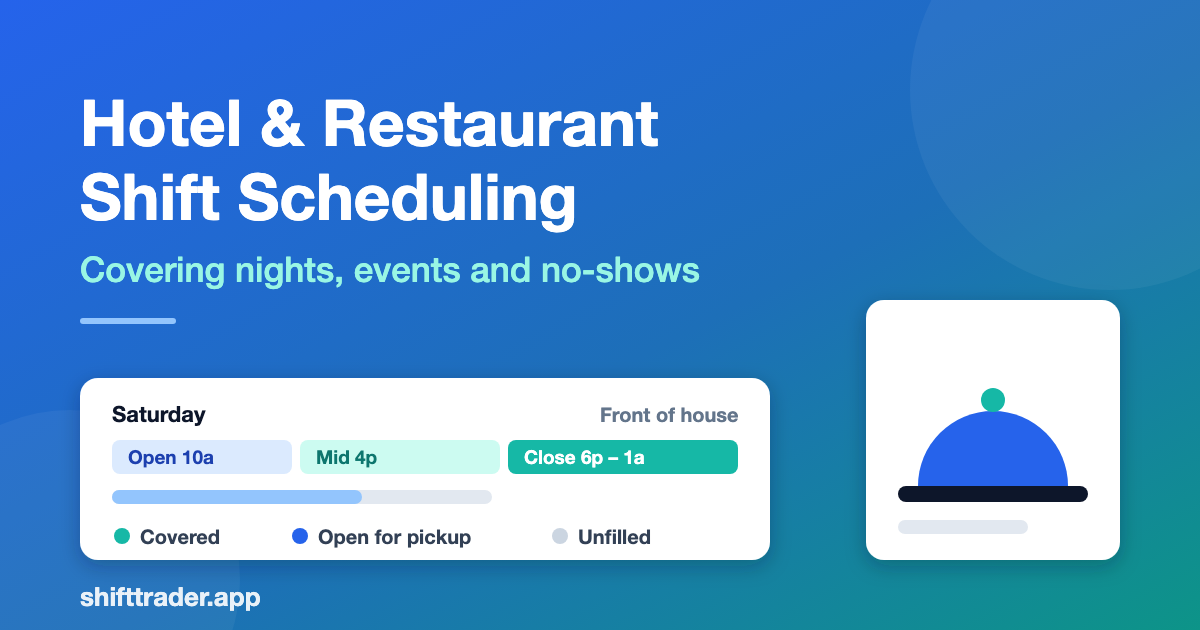
The most common mistake in restaurant shift scheduling is thinking in days. A Saturday isn't a unit of work — it's a prep block, a lunch service, a quiet mid-afternoon, a dinner service, and a close. Each has a different headcount, and staffing the day as one block guarantees you're over-staffed at 3pm and short at 7pm.
Build each day as a set of service periods, and for each one write down:
- Headcount by role — a line short one server is a different problem from being short one line cook
- Start time relative to the rush — shifts should start before the spike, not at it
- Who can close — the constraint that gets forgotten until 11pm
- Overlap deliberately — a handover with zero overlap is a handover that doesn't happen
Hotels have the same structure with different names: check-out block, mid-day turnover, check-in block, night audit. Housekeeping load tracks departures, not occupancy — a full hotel with no departures is a light housekeeping day, and scheduling to occupancy alone will consistently mis-staff it.
Finding Your Real Peaks
You don't need forecasting software. Pull covers by hour from the POS, or arrivals and departures by hour from the PMS, for the last four to six weeks. Most operations find:
- A sharp, short lunch spike and a longer, later dinner plateau
- A Friday that behaves like a Saturday and a Sunday that doesn't
- Check-out load compressed into a two-hour window, check-in spread across five
- One or two nights a week that don't justify the staffing they've always had
That last one is where the savings are. The shift nobody has questioned in a year is usually the one to cut, not the peak everyone argues about.
The 24-Hour Problem
Hotels, late-night venues, and anywhere running overnight have a scheduling problem the rest of hospitality doesn't: shifts that cross midnight.
This causes real, recurring errors. A shift entered as 10pm–6am gets recorded on the wrong day, counted in the wrong week, or silently truncated to zero hours by tools that assume a shift starts and ends on the same date. Payroll disputes over night audit and overnight security hours almost always trace back to this.
Two practical rules:
- Pick a convention and write it down. An overnight shift belongs to the day it starts. Apply it everywhere — schedule, timesheet, payroll — so nobody is reconciling two different answers.
- Test whatever tool you use. Enter a 10pm–6am shift and check what it reports. A surprising number of scheduling tools get this wrong, and you want to find out during a trial rather than during a payroll run.
The same applies to consecutive-nights limits. Someone rotating from nights to days needs a gap, and if your schedule counts by calendar date it will show a legal-looking turnaround that isn't one in practice.
Events Are a Separate Schedule
A wedding, a conference, a match day, a holiday weekend — these aren't a busier version of a normal week. Staffing them off the regular schedule is how you end up paying agency rates on the Thursday before.
Treat each event as its own staffing plan, built backwards from the run sheet:
- Confirm the event headcount six weeks out, not the week before
- Fill it from the existing team first by opening the shifts to everyone before going external
- Build in a float — one or two extra people on the day, because event no-shows cost more than event over-staffing
- Freeze swaps once the plan is final. This is the one time a blanket freeze is justified; a swap on an event day can move someone off a station nobody else is trained on.
Seasonal peaks work the same way at a longer horizon. Whatever your season is — summer, ski, conference, holidays — the staffing plan needs to exist before the season starts, not adapt into it.
Availability Rots Faster Here Than Anywhere
Hospitality runs on students, second-jobbers, and part-timers whose availability changes constantly — and almost nobody tells you until they can't work the shift you already scheduled them for.
Re-collect availability on a fixed cadence rather than waiting for it to break. Quarterly is a reasonable default; at term boundaries if your team is heavily student-staffed. Ask for three things and nothing more: days unavailable, maximum shifts per week, and whether they can close. A longer form gets fewer honest answers.
Then make it clear that availability is a commitment, not a preference. The team that treats it as a wish list is the team where the published schedule falls apart in week one.
Swaps and No-Shows: The Ongoing Cost
Once the schedule is out, two things consume manager time indefinitely: people who need out of a shift, and people who don't turn up.
The second is partly a symptom of the first. When there's no legitimate way to hand off a shift, some fraction of those shifts become callouts instead — and a callout at 4pm on a Friday costs vastly more than a swap arranged on Tuesday would have. Making swaps easy is a no-show reduction strategy, not just a convenience.
What a workable swap process needs in hospitality specifically:
- Station and section awareness. A server trading with a server trained on the same section is fine. Trading with a host who's never run it is not. The rules should encode that.
- Both trades and one-way pickups. Someone who needs Saturday off doesn't always have a shift to offer back. If the only supported transaction is an even exchange, half the handoffs fall back to the group chat.
- Everyone sees open shifts immediately. Coverage speed is the whole game on a same-day callout. A shift only the manager can see is a shift the manager is filling personally.
- A hard stop on event days, as above.
Write these down before you need them. Our shift swap policy template covers notice periods, eligibility, approvals and overtime — the clauses hospitality teams end up arguing about at the worst possible moment. If you're comparing tools rather than writing rules, our guide to choosing a shift swap app covers what to look for.
What to Track
Four numbers tell you whether the schedule is working. None require special software.
- Changes after publishing. High numbers mean your availability data is stale, not that your team is difficult.
- Time to fill an open shift. Measured from posted to covered. If this is measured in hours, coverage is fine. In days, the team can't see open shifts.
- Callout rate by service period. If one shift generates most of your callouts, that shift has a problem — the timing, the section, or the person always assigned to it.
- Overtime created by cover. Covering a shift with someone already at 38 hours is the expensive fix. Catching it at approval time is cheap.
Where a Tool Helps
Hospitality staff scheduling stops being something one person can hold in their head at around 15 staff, or the moment you have two departments with different constraints. What you're buying at that point is a shared source of truth: one schedule everyone sees, changes recorded rather than remembered, and swaps that happen between employees without routing through your phone at 11pm.
Shift Trader handles the swap side specifically: employees enter shifts in seconds on a phone, everyone in their group sees the same schedule, and shifts can be offered for trade or pickup with both sides notified by email. Shifts can cross midnight without breaking, and overlapping shifts are rejected before they're created — so a covered shift can't quietly become a double. See how it works for hotel and restaurant teams.
The Short Version
Schedule service periods, not days. Decide how overnight shifts are counted and apply it everywhere. Build event staffing six weeks out with a float, and freeze swaps once it's final. Re-collect availability quarterly. And give the team a legitimate way to hand off shifts inside rules you've written down — because the alternative isn't fewer swaps, it's more callouts.